
About me
I am occupied with one question.
How do organizations need to be designed and led so that they can act and learn effectively under conditions of dynamics and complexity?
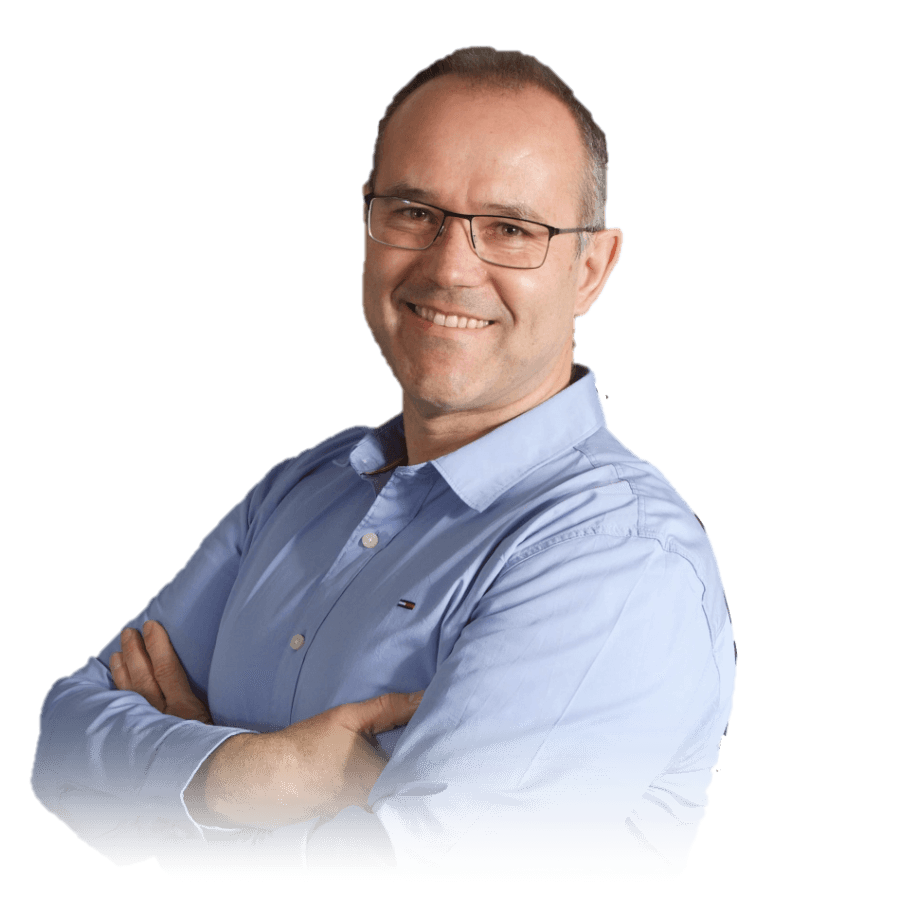
This question did not come from a book. It grew over thirty years, and at the beginning it was a much smaller one.
One job, one customer, one result
I started with an apprenticeship as a telecommunications electronics technician at Siemens in Mannheim. I finished it six months early and was then deployed as a rapid service technician: a company car, a list of customer jobs, and the rest was up to me. Sourcing material, arranging appointments, laying cable, programming systems, explaining the installation to the customer, preparing the job for invoicing.
My responsibility did not end with the technical work. The customer’s workplace had to be in perfect condition afterwards. If I noticed something that was formally outside the job but mattered for a convincing overall result, I took care of it.
I did not know at the time that I was practicing end-to-end responsibility. I only knew that it gave me pleasure when something complete stood at the customer’s site in the end.
When it works
After studying communications engineering at Karlsruhe University of Applied Sciences, I moved to Siemens in Munich in 1997 as a software engineer. In Mannheim people had always spoken about the specialists in Munich. For me the step felt like moving from a local league to the Champions League.
The telecommunications system I worked on was too large for one person to grasp. If I still wanted to be responsible for a result from beginning to end, I needed a different perspective. I found it at the level of a feature and its value to the customer.
One moment I remember particularly well. I called one DECT phone from another. The connection did not go through. Shortly afterwards the envelope symbol lit up on the phone that had been called. One key press, the number of the missed caller was dialled, the connection was there.
I had not written code and I had not finished a component. I could use the complete customer feature. A requirement and many technical steps had turned into visible value.
Where ability meets conditions
In 2000 I moved to the mobile networks division, to Radio Commander, a management system for large mobile networks. An internationally distributed system across three sites with more than 200 developers. Until 2007 I worked there as a developer, sub-system owner and sub-project manager. Technically I learned a great deal. At the same time the distance grew between my work and what someone eventually used.
During that time I became aware of something that shapes my view to this day. Many of the difficulties we struggled with did not come from technical complexity. They came from structures, divided responsibilities and a project landscape that produced dependencies and conflicting goals. People worked on their tasks with commitment and still found it hard to arrive at a coherent overall result.
The people who set those conditions were far away from me at the time. I saw no way to change them and concentrated on my own sphere of influence.
One sentence from my manager at the time has stayed with me. He handed me a project although a colleague seemed the more obvious choice technically. When I asked why, he answered roughly this:
I want you to do it. Then I know something will come out of it that has an effect, and that we will not search endlessly for the best and most elegant solution without a real customer feature ever appearing.
I was immensely proud of that. And it still describes what matters to me: the technically most elegant solution creates no value as long as it does not reach the customer.
That it can be done differently
In 2007 Nokia took over the Siemens networks division. Before the merger I was offered the chance to join a new team on a Nokia project. That project worked with Scrum and with Large-Scale Scrum. For me it was the first contact with agile product development.
Suddenly much of what I had been missing was there: shared responsibility for a product, close collaboration, fast feedback, continuous learning, and considerably more influence for developers over their own work.
I did not just experience a new method. I experienced a different system of work. That time was one of the best of my working life, and it is still the real reason for what I do. I want to make such conditions possible for other people.
The decision
In 2009 I was asked whether I wanted to become an internal agile coach. My first reaction was not only enthusiasm. The decision frightened me, because it meant moving further away from technical work. Developing software and creating working products was an important part of my professional identity.
So I asked myself a more fundamental question: what actually gives me pleasure, in my work and in my life?
At the time I was the father of three daughters. I thought about my experiences with my children, with colleagues and in sport, and I recognized a pattern. What gave me the most pleasure was accompanying people in their development and helping them grow beyond what they had believed they could do.
That settled it.
During that period the organization was coached by Bas Vodde and Craig Larman. So I did not learn about organizational change from books, but over several years as an employee, developer, Scrum Master and internal coach. I know transformations from the perspective of those whose daily work changes, and from the perspective of those who shape them. I know the energy that arises when people are given more responsibility and more feedback. And I know the uncertainty when familiar roles and parts of one’s professional identity are called into question.
LeSS, without calling it that
When it became clear that telecommunications development would move to Asia, the next question arose: how do I become a better coach? The answer was the same as it had been for me as a developer. Through practice, and through practice as varied as possible. I wanted to understand which problems arise from a particular context and which patterns repeat across organizational boundaries. So in 2011 I moved to Valtech.
One of my first projects there was the Unified Sales Platform at the BMW Group. I was responsible for the agile process, and we put Large-Scale Scrum to work with two successful go-lives.
Craig Larman came into that project. He looked at the organization and at the changes we had introduced together with the people involved. And he observed that I had implemented essential elements of Large-Scale Scrum without ever calling the approach by that name.
That observation was valuable to me. I had not imposed a framework on any organization. The starting point was the situation, the visible problems and the question of which structures lead to more end-to-end responsibility, more learning and more customer value. Along that path a design had emerged that matched essential LeSS principles.
That work was the occasion. The path led through writing the public case study. This sounds like documentation, but it was the opposite: only in writing did I have to justify why each decision was taken and what effect it had. Craig accompanied me and supported my development. The collaboration turned into mentoring, and Craig officially became my mentor on the way to becoming a Certified LeSS Trainer.
The certification process took about eighteen months and was one of the hardest and most frustrating phases of my professional development. Craig was relentless in his standards of quality. Again and again I thought I might not make it. At the same time I knew that even if I did not, I would learn so much in the process that I would work at a considerably higher level afterwards.
From people to organizations
From 2011 to 2023 I was Principal Consultant at Valtech. There I built the Organizational Design & Cultural Change practice and led it professionally. In the beginning we were four people with agile knowledge, but none of us had worked as an agile coach or Scrum Master before. The others came from architecture and project management. It grew into a unit with more than 25 coaches.
That included recruiting, mentoring, career paths, a shared understanding of quality and commercial responsibility. What mattered most to me was not the growth, but that a structure emerged which could increasingly act independently of individual people.
In client engagements I worked with developers, teams, managers and executive teams, from single teams up to transformations involving more than 1,000 people. One thing showed itself again and again: many challenges that look like problems of individual people, teams or methods can only be understood when strategy, structure, leadership, decision paths, product development, architecture, skills and incentives are considered together.
Since 2021 I have also worked independently, and exclusively so since 2023. Today I work as an independent consultant, coach and LeSS trainer for companies of various sizes and industries.
Network and teaching
Since 2017 I have given lectures and workshops on organizational design and cultural change as a guest lecturer at the Business School of OTH Amberg-Weiden, in the master program Digital Leadership & Transformation. There I work with Prof. Dr. Bernt Mayer. The model for equally valued professional and managerial career paths also came out of that work.
I work independently, but never alone. I have worked with several partners in Germany and Austria for years, and I am active as a co-organizer in the LeSS community. When an engagement grows beyond what one person can carry, I can scale.
My networkThe question grows
From
how do I become a better developer
came
how do we develop better products
which became
what conditions do people need in order to take responsibility, to learn and to do good work
and finally
how do organizations need to be designed and led so that they can act and learn effectively under conditions of dynamics and complexity
This last question describes the core of my work today.
What drives me
A substantial part of my motivation is contributing to the long-term competitiveness and future viability of Europe. Europe is in intense technological, economic and geopolitical competition. Companies and institutions need the ability to act independently, innovatively and effectively, including under difficult conditions.
This motivation is personal. I want to help ensure that my three daughters and their generation find a future worth living in Europe, with good and properly paid work.
Organizations should be able to shape their future under their own power. Economically capable, technologically sovereign, humanly attractive, adaptable and resilient.